Balephi River Kayaking | 1-Day Class III+ Trip in Nepal

Balephi River Kayaking

Starting Point

Starting Point Kathmandu (Thamel)

Duration

Duration 1 Day

Difficulty

Difficulty Class III+ with IV− sections (kayak-rated)

Activity

Activity Whitewater kayaking (individual kayak, safety-kayaker backed)

Max. altitude

Max. altitude 820 m

Best Season

Best Season March to June, September to November

Distance

Distance 16 KM

Group Size

Group Size 1 to 14 paddlers

Ending Point

Ending Point Kathmandu (Thamel)

Why You Will Love Balephi River Kayaking

  • A tight, technical boulder-garden river with constant eddy action and precise lines.
  • Clear blue water from the Dorje Lakpa Himalaya through the quiet Helambu valley.
  • Its upper reaches near Manji Village were once run as Class IV+, and what we paddle today from Jalbire still carries some of that character in Class III+ and occasional IV- water.
  • A proven progression river that sharpens boat control and river reading for bigger trips.
  • About 3 hours from Kathmandu via the Araniko Highway, with a final unpaved stretch to Jalbire.
  • Small groups (max 14) so guides can watch each paddler through technical sections.
  • Optional upper section for experienced Class IV paddlers, subject to on-water assessment.

Balephi River Kayaking Overview

Balephi River Kayaking is a 1-day whitewater kayaking trip from Kathmandu to the technical section of the Balephi River. The commercial section we paddle runs from Jalbire down to Sukute. This is a tight, boulder-choked corridor. Rapids follow one another with little break. You need constant reads and precise boat placement. The standard section has Class III+ whitewater with occasional Class IV- rapids.

The Balephi is a narrow boulder-garden river. It drops out of the Dorje Lakpa Himalaya and runs through Sindhupalchok district’s Helambu region. It joins the Sun Koshi system just upstream of Dolalghat. It is one of the smaller rivers we run, and one of the most technical. Large rocks, undercut sections, frequent eddies, and close-running rapids make it more technical than its size may suggest. The river does not depend on large waves or high volume to create a challenge. Instead, it requires accurate line choice, good boat control, and quick river reading.

This kayaking trip on Balephi River suits paddlers with basic whitewater experience. A confirmed roll in moving water and comfortable Class II–III boat control are required. It is also useful for paddlers who want to improve their technical skills before taking on larger rivers.

Kayaking has been offered on the Balephi alongside our rafting trips for as long as we have operated here. Paddlers chasing big names like Bhotekoshi, Sun Koshi, and Karnali often overlook the Balephi. For anyone who wants to sharpen boat control and river reading, it is one of the better days on our program.

1-Day Detailed Balephi River Kayaking Itinerary

Day 1: Kathmandu to Balephi and Back

The Balephi River kayaking trip starts with departure from your hotel in Kathmandu at around 7:00 AM. The drive follows the Araniko Highway. There will be a 20-minute tea and coffee stop (self-pay) at Zerokilo, roughly 1.5 hours in. From there, the journey continues past Dolalghat towards Balephi. Jalbire, our actual put-in, sits off the main highway. At the Balephi turn-off, the route leaves the paved Araniko Highway for a rougher, unpaved access road down to the river. The final stretch is slower and bumpier than the highway driving before it. Expect around 3 hours of driving to reach Jalbire.

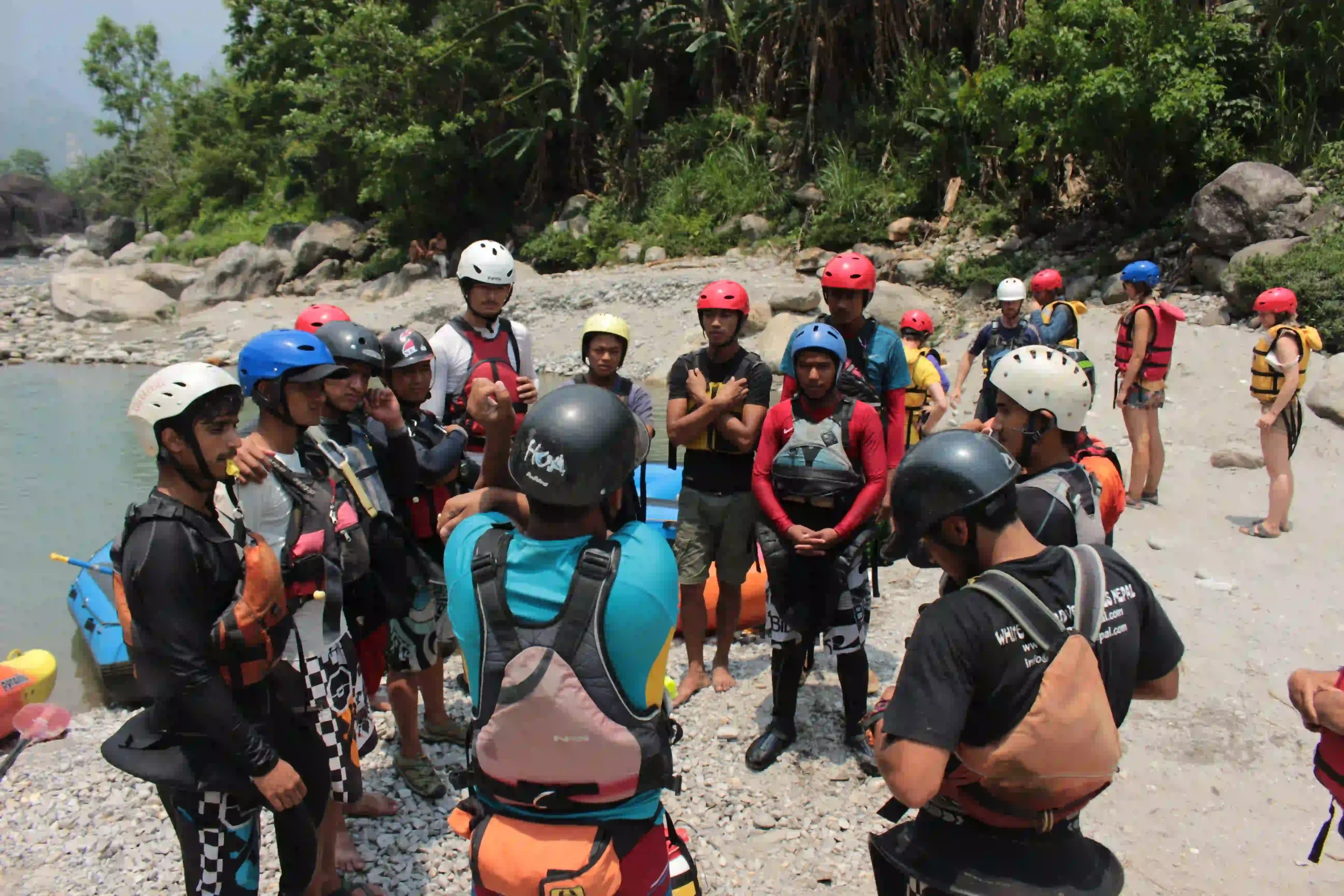
After reaching Jalbire, you will have around 30 minutes to prepare the kayak and equipment. The guides then provide a safety briefing on kayaking on Balephi River, covering paddling technique and rescue procedures. The guides also complete an on-water skills check before the main river section. The kayaking section follows Class III+ boulder-garden whitewater with occasional Class IV- sections, down to our take-out at Sukute. Guides stay with the group throughout the run. They can also point out suitable places for a swim or cliff jump if conditions allow.

Note on water levels: The Balephi is water-level dependent. This tight, technical boulder-garden run needs the right flow to be runnable and enjoyable. We monitor conditions closely and may adjust plans around what the river is doing on a given date.

What to Bring

  • Shorts or half pants
  • Sport sandals with secure straps
  • Quick-drying shirts
  • Swimsuit
  • Warm layers (fleece, trousers) for the drive
  • Towel
  • Toiletries
  • Sunscreen, lip balm, and UV-protection sunglasses with a retaining strap
  • Camera
  • Water bottle
  • A little cash (for the self-pay tea/coffee stop at Zerokilo)

Note: We provide a kayak, helmet, paddle, PFD, and spraydeck. Check “Suitable Kayak for the Balephi River” below if you’d rather bring your own.

What’s Included

  • Professional English-speaking, licensed guides trained and safety-certified to international standards in Whitewater River Guiding, Swift Water Rescue, and Wilderness First Aid
  • Professionally trained and certified safety kayakers
  • Kayaking equipment: Whitewater kayak (fleet or hired in, fully included), helmet, paddle, PFD, spraydeck, dry bags
  • Treated drinking water
  • Two-way transportation from Kathmandu
  • River permits
  • Industry-standard first aid kit
  • Team photos and video
  • Lunch

What’s Not Included

  • Visas, flights, and other taxes
  • Personal items (toiletries, clothing, camera, etc.)
  • Alcohol and packaged snacks
  • Insurance (paddlers need their own policy; we insure our crew only)
  • Tips for guides (paid fairly by us, optional to add personally)
  • City hotel accommodation (available at extra cost; let us know your preferences in advance)
  • Optional domestic flight arrangement

Whitewater Features That Make Balephi Special

The Balephi has different characteristics along its upper and standard sections. Its upper reaches are steeper and more demanding. The section we paddle today (standard) is milder, but still technical and rewarding.

Upper River (Manji Village to Chanaute):

The upper river from Manji Village through Kartike to Chanaute has historically been rated Class IV+. Some call it the “mini-Marsyandi” for its steep character. This section has an average gradient of around 11 meters per kilometer. It requires constant eddy-hopping, careful scouting, and portaging where lines demand it.

Note that this upper water is not part of the standard day trip, but it is not off-limits (we may operate this for experienced paddlers).

Standard Section (Jalbire to Sukute):

It is the section we paddle today. The standard commercial section from Jalbire to Sukute is milder than the upper river. It still provides continuous Class III+ whitewater with occasional Class IV- sections. The channel is narrow and full of boulders. Some boulders are undercut, so paddlers need to choose their lines carefully. The water runs a clear blue.

Rapids come in close succession, which means you will read and catch eddies almost continuously, rather than getting long flat recovery stretches. In this way, it is a technical river in the truest sense. It rewards reading water and placing your boat exactly where you mean to.

Optional Upper Balephi Section for Experienced Paddlers (Kartike/Chanaute to Jalbire)

The upper Balephi is not part of the standard 1-day trip. If you already have real Class IV experience, you can ask about running part of the upper Balephi as an extension.

How the Upper Section Works:

We do not take anyone up there cold. Your run on the standard lower section from Jalbire serves as our on-water assessment. Guides assess your balance, boat control, roll, and line-reading skills. If your paddling meets the requirements of the upper section, the guides can confirm the extension.

This is not a fixed add-on that can be confirmed in advance. The decision depends on what the guides see during the standard section.

Upper Balephi Sections:

The Chanaute to Jalbire section is about 7 KM. The Kartike to Chanaute section adds another 2 KM. Some groups use Dhande as a shorter option. It is around 15 to 20 minutes above Jalbire and provides a middle-ground option between the standard run and the full Kartike/Chanaute extension.

Whichever put-in, the upper section requires genuine Class IV kayaking skills. It has narrow channels, large undercut boulders, strong holes, and technical sections where scouting, portaging, and eddy-hopping are important parts of the descent. This is not water where you should treat a capsize as a minor problem. Paddlers need strong balance, reliable boat control, and maneuvering to stay upright through technical sections.

Requirements for the Upper Section:

  • Demonstrated Class IV kayaking experience, confirmed on the water during the standard section.
  • Personal travel insurance that explicitly covers Class IV whitewater kayaking. (We will need to see the documentation before arranging this section).

Note: If you are interested in the extension, mention it when booking. The guides can then allow time for the on-water assessment.

Suitable Kayak for the Balephi River

Boat choice is important on Balephi because of the boulder-garden terrain and undercut rocks. A creekboat is the standard choice for this river. Its higher volume and rocker help the kayak resurface and reduce the risk of pinning in tight, rocky sections.

Experienced technical paddlers comfortable with precise edge control may also choose a half-slice. This type of kayak can reward active edge control and precise boat placement this river demands. It also gives less margin for error around undercut rocks than a creekboat.

On our Balephi Kayaking trip, we use a fleet such as Dagger Nomad, Pyranha, Jackson Karma, and Bliss-Stick Mystic models. Availability can vary by size and model. The trip price includes a suitable kayak from the fleet. If the required boat is not available, we will arrange one through a partner outfitter. Also, if you already paddle a particular boat at home, tell us the model and size. If you are unsure, send us your height, weight, inseam, shoe size, whitewater experience, and roll experience, then we will recommend one from the fleet.

Balephi River Difficulty and Experience Requirements

The Balephi offers different experiences for rafting and kayaking. As a Balephi rafting trip, it is accessible to people without prior experience. Guides handle the technical sections and provide the required safety support.

In contrast, Kayaking is different. The boulder-garden terrain, undercut rocks, and continuous eddy-hopping require good boat control. A confirmed roll in moving water is required.

The Balephi Kayaking is a good fit for paddlers with foundational whitewater kayaking skills. You should have a reliable roll and feel comfortable with Class II–III boat control. If you are completely new to kayaking, this is not the right river to start with. You may take our shorter kayak training program before attempting Balephi. For the kayak training program, kindly contact us.

Minimum age: For rafting, children under 8 are not recommended because the Balephi has stronger rapids than gentler rivers such as the Trishuli. For kayaking, there is no fixed age requirement stated here. The key requirement is confirmed roll and boat control in moving water.

What Skills Can You Improve on the Balephi River?

Balephi gives paddlers repeated opportunities to work on technical whitewater skills. For example, the narrow channel requires quick river reading. Frequent eddies provide opportunities to practice entering and leaving the main current. The boulder gardens also require accurate boat placement.

During the run, paddlers improve the following kayaking skills:

  • Eddy-hopping
  • River reading
  • Technical line choice
  • Boat placement
  • Edge control
  • Decision-making
  • Paddling around boulders and undercuts

These skills can be useful when paddling more demanding technical sections on larger Himalayan rivers.

Why Balephi Is a Good Progression River?

Balephi is genuinely a good progression river because its technical boulder-garden sections build skills that are useful on bigger whitewater rivers. You learn precise eddy-hopping, reading fast and tight lines under pressure, and quick decisions in close-following rapids. Big-volume rivers do not teach this in the same way.

Not to mention, those are exactly the skills that show up in the technical sections of Nepal’s bigger expedition rivers. Boulder-garden rapids such as Meat Grinder, Punch, and Judy on the Sun Koshi require the same kind of precise boat placement and technical control. For paddlers preparing for the Sun Koshi, Bhotekoshi, or longer trips such as the Multi River descent, a day on the Balephi can help sharpen these skills.

Best Season for Balephi River Kayaking

The main seasons for Balephi River kayaking are March to June and September to November. From September to November, post-monsoon flows and generally stable weather create good conditions for the river’s technical boulder-garden sections. Likewise, from March to June, snowmelt increases the flow while generally providing clear conditions and good visibility of the river’s boulder lines.

During the monsoon and deep winter, water levels can change more significantly. High water can make the narrow river faster and harder to read, while very low water can expose more rocks and lead to more portaging. Thus, at Nepal River Runner, before every departure, we check the river to assess current conditions and make appropriate decisions for the trip.

Balephi vs. Bhotekoshi Kayaking

Balephi and Bhotekoshi both offer technical whitewater close to Kathmandu. However, the rivers have different characteristics and test different paddling skills.

Feature Balephi Kayaking Bhotekoshi Kayaking
River character Narrow boulder-garden, tight lines, undercuts, rapids running close together Wider wave-train river, more open recovery pools between rapids
Core skill tested Eddy-hopping, precise boat placement, technical line-reading Reading and riding continuous big-volume wave trains
Difficulty Class III+ with IV- sections Class III/III+, continuous
Best for Paddlers wanting to sharpen technical control Paddlers wanting continuous big-water mileage

Neither is meaningfully “easier” than the other in a kayak. Both are genuine Class III+ days that require a confirmed roll. The difference is what they demand of you. The Balephi tests precision, while the Bhotekoshi tests continuous big-water reading.

The two rivers can also be combined into a 2-day kayaking trip, as our Bhotekoshi and Balephi 2-day combo trip. This trip gives paddlers the chance to experience both technical boulder-garden water and continuous big-water sections.

Balephi River Kayaking FAQs

Balephi is not recommended as a first kayaking experience for beginners. The standard section requires a confirmed roll in moving water and comfortable Class II–III boat control. Paddlers need to understand basic river features and follow the guide’s instructions through technical sections.

The section we run commercially, Jalbire to Sukute, is Class III+ with occasional IV− rapids. It is narrow, boulder-choked, and technical rather than big-volume. Historically, the river’s upper reaches above Manji Village have been rated Class IV+. That section is not part of our current commercial operation.

Neither is “better.” They teach different things. The Balephi sharpens technical precision. The Bhotekoshi builds continuous big-water reading. Both require a confirmed roll for kayaking. Many paddlers benefit from running both. That is what our 2-day combo trip is built around.

Autumn (September to November) and spring (March to June) are the most reliable windows. Outside those months, water levels swing enough that a narrow, technical river like this one can run too pushy or too low to enjoy properly.

You can paddle the upper Balephi only if you already have real Class IV experience and it is confirmed on the water. Your run on the standard Jalbire section serves as the assessment. If your guides see the boat control and line reading the upper water demands, we can arrange the extension from there. You will also need travel insurance that explicitly covers Class IV whitewater kayaking. We will ask to see documentation before confirming. It is not something we can pre-book sight unseen.

No, you don’t need your own kayak for Balephi Kayaking. A whitewater kayak, helmet, paddle, PFD, and spraydeck are included in our trip package price. That said, you can also bring your own boat if you prefer. Tell us the model and size when you book.

You need a reliable roll in moving water. The river has tight boulder gardens and some undercut rocks. A weak or inconsistent roll is not enough for this trip

Absolutely, you can join as a solo traveler. Our group size runs from 1 to 14. You do not need to bring your own group to book this trip.

Expect about 3 to 4 hours of active paddling, depending on water levels and group speed. The rest of the day is drive time, briefing, and gear fit.

We monitor water levels before every departure. If the river is unsafe or not enjoyable, we may adjust the section, change the date, or offer an alternative river where possible.

Our fleet covers a wide range of body sizes. If you are very tall, very short, or outside average weight ranges, tell us when you book. We will match you with a suitable boat from our fleet or hire one in.

You can bring a camera, but only if it is in a proper waterproof case or dry bag. We do not recommend expensive electronics on the water. If you swim, unsecured items can be lost.

Where conditions allow, and the group is comfortable, guides may point out safe spots for a supervised swim or cliff jump. This is optional and depends on water levels and time.

Whitewater kayaking involves jolts, braces, and quick moves. If you have a recent or serious injury, talk to us before booking. We can advise whether this 1 day Balephi Kayaking trip is suitable for you.

Yes, you need travel insurance. Your policy should cover whitewater kayaking up to the grade you will paddle (Class III+ with IV− sections). If you plan to attempt the optional upper section, your insurance must explicitly cover Class IV whitewater kayaking.