Bhotekoshi Kayaking, Class III+ | Nepal River Runner

Bhotekoshi River Kayaking

Starting Point

Starting Point Kathmandu

Duration

Duration 1

Difficulty

Difficulty Class III-III+ (Intermediate)

Activity

Activity Whitewater kayaking in individual kayaks, supported by safety kayakers

Best Season

Best Season March-June and September-November

Distance

Distance 13KM

Group Size

Group Size Minimum 1, Maximum 14

Ending Point

Ending Point Kathmandu

Why You’ll Love Bhotekoshi River Kayaking

  • Paddle continuous Class III/III+ rapids in one day, without committing to a multi-day expedition.
  • Reach the river in about 3 hours from Kathmandu via the scenic Araniko Highway and return the same day.
  • Take on a steady 7-meter-per-kilometer gradient, with fast wave trains, boulder channels, and calmer pools between rapids.
  • Test your kayak control and precision on technical rapids that demand more skill than the same river’s rafting sections might suggest.
  • Benefit from our experience on this exact stretch since 2011, with over a decade of hands-on knowledge of its rapids and changing conditions.
  • Fit kayaking into a longer Nepal trip by pairing it with a trek or bungee jumping at The Last Resort upstream.

Overview

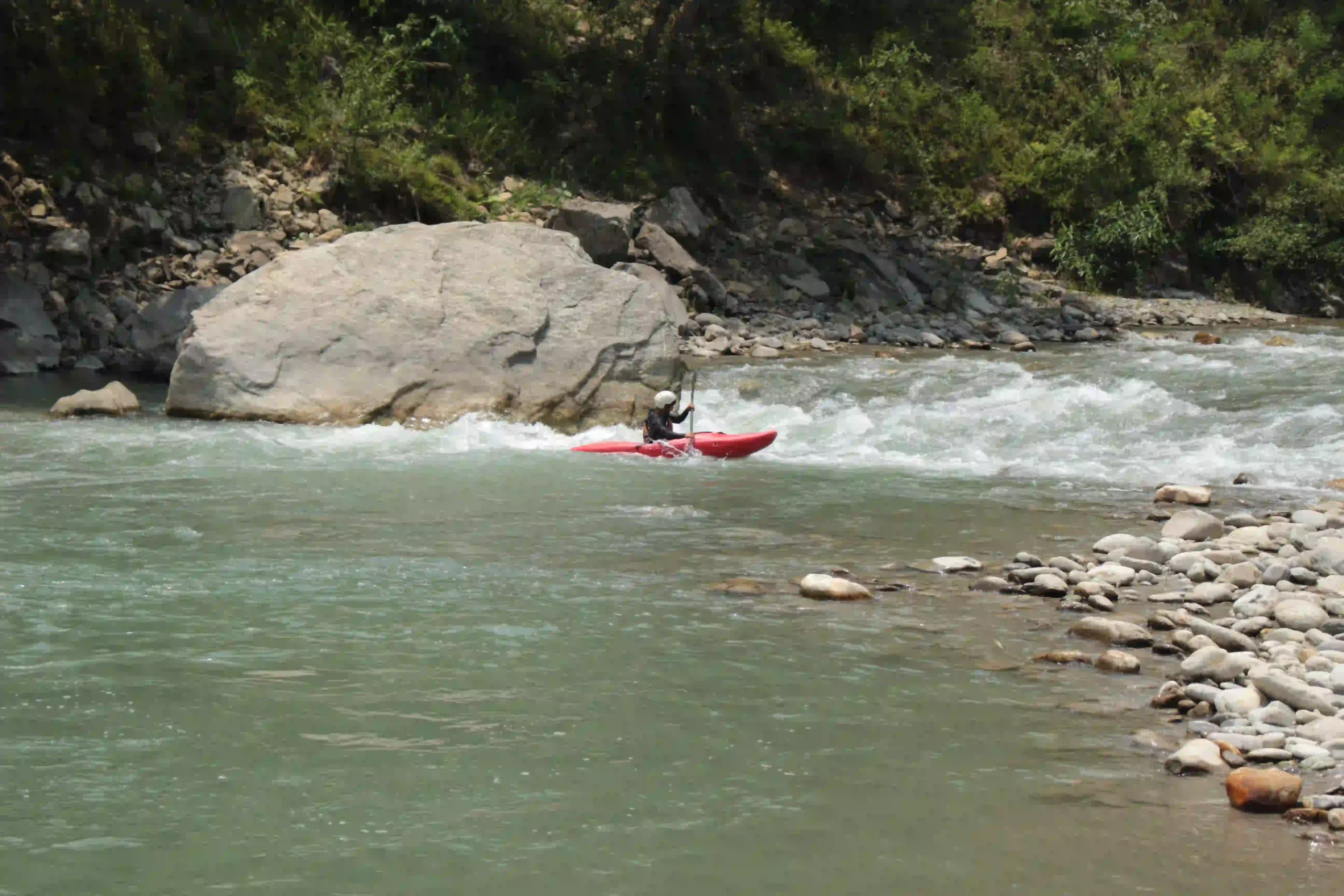
The Bhotekoshi is one of Nepal’s most accessible one-day whitewater kayaking trips. It offers 13 km of continuous rapids on a river fed by the Zhangzangbo Glacier in Tibet. The river is about a three-hour drive from Kathmandu, so you can paddle and return in a single day.

The steep upper canyons near the Tibet border once held some of Nepal’s wildest commercial whitewater. However, that section is not currently run commercially. Our trip follows the Lower Bhotekoshi, from Khadichaur to Sukute Beach. Here, you’ll paddle continuous Class III/III+ rapids with a steady gradient. The river has fast wave trains and boulder channels, with wide, calmer pools between rapids where you can recover before the next section. The water is demanding enough to make this a proper technical day out, not a warm-up.

The difference between kayaking and rafting matters here. In a raft, this river is a great first-timer trip. A guide steers the boat, everyone paddles together, and the raft absorbs much of the technical demand. In a kayak, you read and run every wave train yourself. You need to judge the water, choose your line, and control your own boat through the rapids.

Therefore, you should have solid intermediate whitewater skills and a reliable roll before joining. This is not a beginner kayaking introduction. It’s a proper Class III/III+ day on the water for paddlers who already have some boat time behind them.

Day 1: Kathmandu to Bhotekoshi and Back

Your day starts at 6:30 AM at our office in Thamel, Kathmandu. From there, we drive east along the Araniko Highway for about three hours. We’ll stop for 20 minutes at Keraghaari Organic Coffee and Lassi Shop, roughly halfway, where you can grab tea or coffee at your own expense. Once we reach Khadichaur, we’ll spend around 30 minutes fitting your kayak and gear.

Before getting on the water, you’ll receive a full safety briefing covering paddling techniques, rescue procedures, and an on-water skills check. Then it’s time to paddle. The Lower Bhotekoshi brings continuous, fast-paced Class III/III+ wave trains and bouncy boulder channels. Expect around 2-2.5 hours of active paddling, with plenty to keep you focused. If river conditions allow, your guides can point out safe spots for an optional swim or cliff jump along the way.

The trip finishes at our beachfront base in Sukute, where you’ll enjoy a hot or cold buffet lunch by the river. It’s a chance to relax, refuel, and share stories from the rapids before heading back. We leave Sukute at 5:00 PM and arrive at our Thamel office in Kathmandu to wrap up the day.

Cancellation policy: If you cancel after booking, 30% of the trip amount is non-refundable. The date we receive your written cancellation determines the applicable cancellation date. If you choose to leave the trip after it has started, you won’t receive a refund. Unused transport, meals, and other services are also non-refundable.

What to Bring

  • Shorts or ½ pants
  • Sport sandals with secure straps
  • Quick-drying shirts
  • Swimsuit
  • Warm layers (fleece, trousers) for the drive and lunch stop
  • Towel
  • Toiletries
  • SPF 50 sunscreen
  • SPF lip balm
  • UV-protection sunglasses with a retaining strap
  • Camera or waterproof action camera
  • Water bottle
  • Small amount of cash for the self-pay tea/coffee stop
  • Change of dry clothes and underwear
  • Lightweight rain jacket or windbreaker
  • Waterproof dry bag for valuables
  • Snacks or energy bars
  • Personal medication
  • Waterproof phone case
  • Secure river footwear for slippery or rocky surfaces

Kayak-specific: Your kayak, helmet, paddle, PFD, and spraydeck are provided. See “Choosing the Right Kayak” below if you’d rather bring your own.

What's Included

  • Professional, English-speaking, licensed guides trained and certified to international standards in Whitewater River Guiding, Swift Water Rescue, and Wilderness First Aid
  • Professionally trained and certified safety kayakers
  • Kayaking equipment, including a whitewater kayak, helmet, paddle, PFD, spraydeck, and dry bags
  • Treated drinking water
  • Round-trip transportation from Kathmandu
  • River permits
  • Industry-standard first aid kit
  • Team photos and video
  • Lunch, with a hot or cold buffet at Sukute

What's Not Included

  • Visas, flights, and other taxes
  • Personal items, including toiletries, clothing, and cameras
  • Alcohol and packaged snacks
  • Insurance: You must arrange your own insurance. We only insure our crew.
  • Guide tips: We pay our guides fairly, so tips are optional.

Bhotekoshi River Kayaking vs. Bhotekoshi River Rafting

It’s the same river and the same rapids, but the experience is quite different. Here’s what to consider before choosing between the two.

Feature Kayaking Rafting
Experience needed Solid intermediate whitewater skills and a reliable roll required No prior experience needed. Certified guides steer, so beginners are welcome.
Who’s in control You choose and navigate your own line The guide leads while the group paddles together
Physical and technical demand High. You read and run each wave train on your own. Moderate. You paddle actively in response to the guide’s commands.
Group experience Individual kayaks with support from safety kayakers Shared raft with a strong team and social dynamic
Best for Paddlers who want to navigate the river themselves Active beginners, families with members aged 10+, groups, and corporate teams

If you don’t yet have a reliable roll in moving water, rafting is the better choice. You’ll experience the same rapids without the technical requirements of kayaking. If you’re confident in your roll and boat control, kayaking offers a more demanding, hands-on experience on the very same stretch of river.

Choosing the Right Kayak for This Trip

The Lower Bhotekoshi has wide channels and recovery pools, giving you more room to recover than on our multi-day expedition rivers. This also gives you some flexibility when choosing a kayak.

A creekboat is a reliable choice for this trip. It handles boulder channels well and resurfaces quickly. If you’re a confident paddler and prefer a more playful ride, a half-slice can also work well. The calmer pools between rapids give you space to play with the boat’s edges without the same risks you’d face on a larger expedition river.

Our fleet includes models such as the Dagger Nomad, Pyranha, Jackson Karma, and Bliss-Stick Mystic. Available models may vary. Your kayak is included in the trip price. We’ll provide one from our own fleet or arrange one through a partner outfitter if we don’t have the right size or model.

Already have a preferred kayak? Tell us the model and size, and we’ll check availability. Not sure which boat suits you? Send us your height, weight, inseam, shoe size, whitewater experience, and roll experience. We’ll recommend a suitable kayak from the available fleet.

Who Is This Trip For?

The Bhotekoshi’s Class III/III+ rapids offer an exciting challenge for experienced kayakers. The Lower Bhotekoshi is a good choice if you want continuous whitewater, technical features, and a full day on the river without committing to a multi-day expedition.

This trip suits paddlers who have:

  • A reliable roll in moving water: You should be confident recovering after a capsize in current, as the continuous wave trains and boulder channels leave little room for long breaks.
  • Confident Class III boat control: You should be comfortable reading rapids, ferrying across currents, and making eddy turns through continuous whitewater.
  • The fitness for a full day out: Expect around 2–2.5 hours of focused paddling, with rapids coming in quick succession.
  • Experience in cold, glacier-fed water: The Bhotekoshi stays cold throughout the year, so you should be prepared for cold-water conditions.

This trip is ideal for kayakers with solid Class III experience who want to test their skills on continuous whitewater. It’s also a great fit for experienced paddlers visiting Nepal on a tight schedule who want a proper technical river day without the commitment of a multi-day expedition.

If you’re an experienced kayaker looking for a more relaxed introduction to the river, the Lower Bhotekoshi’s recovery pools offer some breathing room between rapids. However, this is still a technical run, so come prepared to paddle actively and handle changing river conditions.

Difficulty Level

The Bhotekoshi is rated Class III–III+ (Intermediate) for kayaking. Its steady 7-meter-per-kilometer gradient keeps the river active throughout the route. You’ll encounter continuous wave trains, bouncy boulder channels, and wide recovery pools between rapids rather than just one or two major features.

This continuous flow makes the river more demanding in a kayak than in a raft. You won’t have long, flat stretches to reset between rapids. Instead, you’ll need to read the water, choose your line, and control your kayak through each section.

Why does this river also work as a training run?

The same stretch, known as the Lower Bhotekoshi or, depending on the put-in point, the Upper Sun Koshi, offers opportunities for skill development as well as a challenging day on the water. The water volume is relatively low, and the current isn’t especially pushy. This makes the river manageable for intermediate paddlers while giving experienced kayakers plenty to work on.

Bouldery rapids appear roughly every half kilometer, with long, readable wave trains in between. You’ll find smooth waves to surf, well-defined eddy lines to practice moving in and out of the current, and several holes for working on endos and other techniques.

If you’re new to this river, you can start farther downstream near the Balephi confluence. As your confidence grows, you can gradually move to higher put-in points. This stretch also makes a useful warm-up before tackling the Bhotekoshi at higher water levels. We also run our kayak clinic training here.

Why don’t we run the upper Bhotekoshi?

The steeper Upper Bhotekoshi gorge near the Tibet border once featured some of Nepal’s wildest commercial whitewater, with rapids rated Class IV–V and conditions occasionally reaching Class V at high water. That section is no longer run commercially.

The upper corridor now feeds the Upper Bhote Koshi (45 MW) and Middle Bhotekoshi (102 MW) hydropower projects. Concrete diversion dams at Tatopani and Chaku divert river water into headrace tunnels more than 10 km long.

Monsoon floods have also exposed rebar and jagged rocks in the dewatered upper riverbed, making the historic rapids unsafe to run.

All our commercial trips operate on the Lower Bhotekoshi, from Khadichaur to Sukute, well downstream of the diversion dams and flood debris. This stretch flows naturally and offers continuous Class III/III+ whitewater. We’ll only reopen the upper section once the river and surrounding slopes have been inspected and confirmed safe.

Why International Paddlers Love Bhotekoshi River Kayaking

If you’re short on time in Nepal, the Bhotekoshi lets you experience real Himalayan whitewater in just one day. The river is about a three-hour drive from Kathmandu, so you can paddle and return to the city the same day. Despite the short trip, you’ll get continuous rapids, strong currents, and a genuine roll requirement. This is a technical kayaking experience, not a guided float.

You can also fit the trip into a longer Nepal itinerary. Pair it with a trek in Langtang, Everest, or Annapurna, or visit The Last Resort upstream. The resort is known for its 160-meter bungee jump and sits around 22 km upstream of our put-in point at Khadichaur.

Best Season for Technical Whitewater on the Bhotekoshi

The best time for Bhotekoshi kayaking is spring (March–June) and autumn (September–November). These seasons offer different experiences, from lower, clearer water in spring to fuller, more energetic rapids in autumn. Winter is also possible if you’re prepared for cold conditions, while we suspend commercial trips during the monsoon because of unpredictable river flows.

Autumn (September–November)

Autumn is the best season for high-volume, energetic whitewater. Post-monsoon flows keep the river full and the rapids continuous. Skies are often clearer, making the drive along the Araniko Highway more enjoyable. Water levels can still vary after the monsoon, so we check conditions before each trip.

Spring (March–June)

Water levels are generally lower, and clearer water makes channels and boulder features easier to read. As temperatures rise, snowmelt from the Tibetan Plateau feeds the river and gradually changes the flow. This is a good time to work on precise lines, eddy turns, and boat control.

Off-Season Conditions

Winter (December–February)

Kayaking is still possible, but the river is generally lower and clearer, and the water is colder. You’ll need suitable cold-water gear and should be prepared for chilly conditions during the drive and riverside breaks. Winter can be a quieter option if you’d rather avoid the busier spring and autumn periods.

Monsoon (July–August)

We don’t run commercial kayaking trips during the monsoon. Heavy rainfall can trigger sudden flood surges, increase sediment levels, and change river conditions quickly. Stronger currents and reduced visibility make it harder to read rapids safely. We resume trips only when conditions are suitable.

Bhotekoshi Kayaking vs. Trishuli Kayaking

If you’re choosing between the Bhotekoshi and Trishuli for a day of kayaking from Kathmandu, the main difference is the level of technical challenge on the water. Both rivers are about a three-hour drive from the city, but the Bhotekoshi offers more continuous Class III/III+ rapids, while the Trishuli has gentler sections and larger pools between rapids.

Feature Bhotekoshi River Kayaking Trishuli River Kayaking
Difficulty Class III/III+, with continuous, fast-paced wave trains Class II+/III, with a classic pool-and-drop pattern
River character Narrower valley, steeper gradient, and more active current Wider riverbed, with larger calm pools between rapids
Kayaking experience Solid intermediate skills and a confirmed roll required More forgiving, making it a reasonable option for newer kayakers with basic roll practice
Location from Kathmandu About 3 hours east, toward the Tibet border About 3 hours west, toward Pokhara and Chitwan
Best for Paddlers seeking concentrated, continuous technical whitewater in one day Paddlers looking for a gentler technical day or a next step after kayak training

Choose the Bhotekoshi if you already have solid Class III skills and want a full day of continuous rapids without committing to a multi-day expedition. Choose the Trishuli if you’d prefer a more forgiving river with calmer pools between rapids. Let your kayaking experience and confidence on moving water guide your choice more than drive time alone.

What Makes This Bhotekoshi Kayaking Package Different?

At Nepal River Runner (NRR), we focus on giving you a genuine whitewater kayaking experience on the Lower Bhotekoshi. With years of experience on this river, a kayaking-focused safety team, and the right equipment included, we make your day on the water challenging, well supported, and easy to plan.

  • Over a Decade of River Experience: We’ve been running this stretch of the Bhotekoshi since 2011, giving us years of hands-on experience with its rapids and changing river conditions.
  • Kayaking-Specific Safety Team: You’ll be supported by safety kayakers trained for whitewater kayaking, not just staff from rafting trips.
  • Honest Skill Requirements: You need solid intermediate skills and a reliable roll to handle continuous Class III/III+ rapids. We won’t put unprepared paddlers on the river.
  • Kayak and Equipment Included: Your kayak and essential gear are included, whether we provide a boat from our own fleet or arrange one through a partner outfitter. There’s no separate rental fee.
  • A Full River Day in One Trip: Experience technical whitewater without committing to a multi-day expedition, with transport to and from Kathmandu included.

FAQs About Bhotekoshi River Kayaking

It’s close, just three hours from Kathmandu, and takes only one day. You get continuous, genuine whitewater rather than a short taste of rapids. Few rivers near the capital offer the same combination. You can also pair the trip with a trek or a bungee jump at The Last Resort.

Not as a first kayaking experience. For rafting, no previous experience is needed. Kayaking requires solid intermediate whitewater skills and a confirmed roll. The continuous Class III/III+ rapids don’t offer the long recovery stretches you’d want on a beginner-friendly run.

Neither is inherently safer. They involve different risks. In a raft, a guide steers while the group paddles together. In a kayak, you’re responsible for controlling your boat and choosing your line, with safety kayakers there to support you. Kayaking demands more individual skill, while rafting requires less prior experience but gives you less individual control.

You need a reliable, confirmed roll in moving water and confident boat control in continuous Class III rapids. This includes ferrying across currents, making eddy turns, and reading your line under pressure. If you’re new to kayaking, start with the rafting trip or one of our shorter kayak training programs.

Yes. Many travelers combine the two activities. The Last Resort’s 160-meter bungee jump is about 22 km upstream of our put-in point at Khadichaur. Our kayaking trip covers the Lower Bhotekoshi only, so contact us if you’d like to plan both activities in one trip.