Why Should You Train Before You Go Kayaking?
If you’re using this summer and monsoon off-season to train before kayaking during our best seasons in Autumn or Spring, it can make a huge difference between struggling to float in the water and confidently flowing with every stroke. Kayaking is not just about paddling. You will be in a small, narrow boat and propelled by means of a double-bladed paddle. Handling the boat might look like swinging your hands here and there in the comfort of the tiny cockpit. However, reality hits you hard like the waves of the feisty rivers you’re about to go into.
Kayaking requires constant balance, adapting to shifting currents, and responding to unexpected resistance from water. You will need to continuously engage your body while relying on your core stability and upper-body strength. While fitness is crucial for this water sport, experience is also important. Thus, training before hitting the water turns the entire experience safer, smoother, and more enjoyable.
Training before you go kayaking also helps you understand how your body moves on the water and what it goes through. You will be surprised how a bit of training can completely change the way you experience the water. To help you train yourself or start a proper workout to prepare your body for a ride, we bring you this comprehensive guide on “why you should train before you go kayaking.” So, make sure you stay with us until the end!
The Physical Demands of Kayaking
For onlookers, kayaking might look like drifting on a fast-flowing river in a boat with a paddle in one hand. But it is not that simple. Once you are in the water, you do not only move in a straight line. Every corner, you have to make small but crucial adjustments. Your paddling strokes affect your direction, speed, and balance. The river is not consistent, with shifts in current, sudden drops, hidden boulders or rocks, and unexpected resistance. These will constantly put your physical fitness, stamina, and strength to the test.
Kayaking is not only an upper-body activity, but a full-body challenge. However, the watersport heavily relies on your upper body strength (arms, shoulders, and back). The main force of each stroke comes from your shoulders and back. Similarly, your arms mainly help to guide the paddle. You need good grip strength to maintain a consistent grip on the paddle and forearm endurance for constant control of movement. Your forearm also absorbs vibrations from the water’s push and keeps your strokes steady.
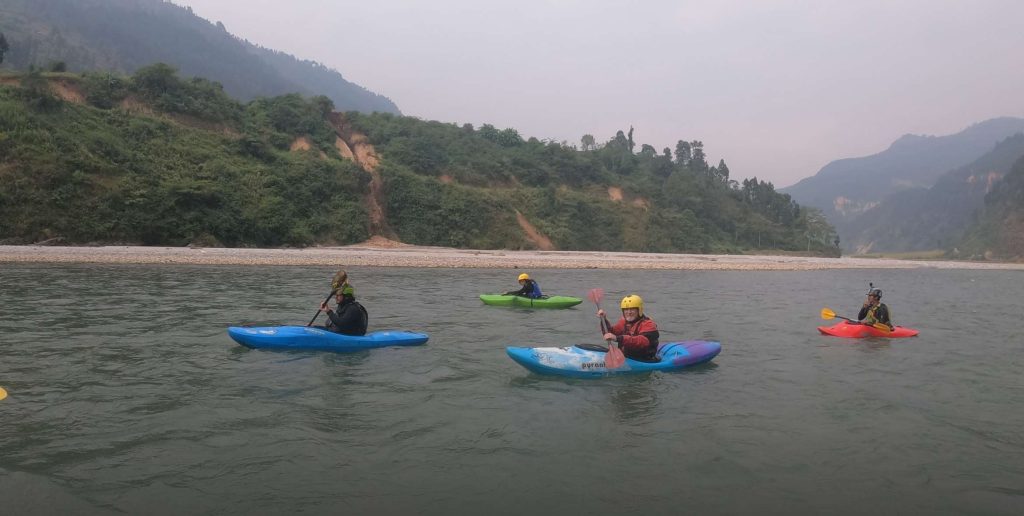
While your shoulders and arms do the visible work, the real stability comes from your core. When you make strokes, you must use your torso, not just your arms. It engages your entire abs and lower back constantly. You have to sit on a narrow boat that reacts to every shift and paddle. Balance is crucial to staying steady and upright. Although you might not see it, your muscles around your hips and core are constantly working. Only by rotating your torso and shoulders can you paddle efficiently. As a result, you need strong core strength to maintain your balance, reduce fatigue, and improve control as water conditions change.
Kayaking is a physically demanding sport that requires strength, stamina, and endurance. Without these, kayaking in the whitewaters, even for a short distance, feels like a struggle. Understanding the physical demands allows you to prepare adequately for the activity.
Major Benefits of Training Before Your Trip
Now that we understand that kayaking is a physically demanding sport, let us move on to the benefits of training before you get into the water. Training not only improves fitness but also shapes your overall kayaking experience. Instead of struggling with your paddle, you will be able to move into the water with more control and confidence. Take a look at the major benefits of training before the actual kayaking trip:
- Train to build the key muscle groups, i.e., core, back, shoulders, and arms, to improve paddling strength and control. It helps to paddle more efficiently, without wasting energy.
- When you kayak, you have to make repetitive movements for hours on fast-flowing water. Sometimes there are multi-day expeditions. Thus, you need to train to improve your cardiovascular endurance for long hours of activity and trips.
- When you are in water, even a small wave or shifts in weight can affect your balance. This is exactly why you need to train your core for stability. It helps improve coordination and balance, even in unpredictable conditions.
- Training before kayaking helps your body and mind adapt to the changes in the water and sudden movements. It allows you to adapt to the real water conditions. Your body movement is smoother, and your strokes are more efficient through the water.
- You may suffer injuries or soreness without proper training. Hence, training before kayaking strengthens your muscles and your joints become flexible. It hugely reduces the risk of straining your shoulder, wrists, and back.
- Another benefit of training before kayaking is that it not only helps with physical preparation but also builds mental confidence. Knowing that you are prepared, you can better adapt to the shifting water conditions. You also feel more relaxed, focused, and in control, making the experience more exciting.
Are Kayaking Training & Rafting Training Similar?
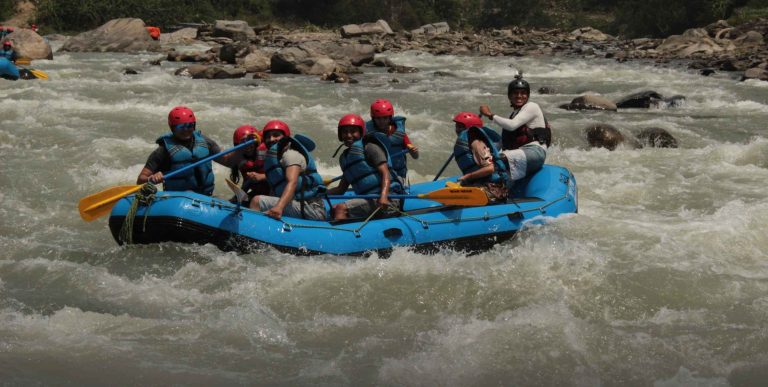
Kayaking and rafting training are similar but differ in some ways. Both water sports require physical strength and endurance. They also involve core strength, balance, and focus. However, they use different techniques, body movements, and equipment. Let us explore their similarities and differences.

Similarities
Both kayaking and rafting training require good cardiovascular fitness as they involve long hours of physical activity in fast-flowing water. Paddlers with good cardiovascular endurance can maintain their energy levels for longer. Similarly, they can paddle more efficiently and recover faster, avoiding early fatigue. While training for both kayaking and rafting, core strength is crucial. Paddlers will need both balance and coordination to react quickly to the changing water conditions, waves, and any other obstacles.
Another similarity between rafting and kayaking is that both require upper-body strength. Participants must paddle repeatedly, which strains their arms, shoulders, and back. The constant motion is physically demanding, and both training focuses on building resistance, control, and improving stroke efficiency. The training also includes mental focus and river reading. Kayakers and rafters need to understand how water moves, identify currents, spot safe routes, and make quick decisions in changing conditions.
Differences
Kayaking is an individual water sport, while rafting is a team sport that requires group coordination and river navigation. Hence, the training is also divided into individual and team-based training. Take a look at the major differences between the two trainings:
- For kayaking training, paddlers need to focus on learning to control the kayak independently. It focuses on individual paddling skills and the ability to handle water conditions. You have to learn paddle strokes, balance, and body movements. Meanwhile, rafting training focuses on paddle synchronization, communication, teamwork, and following the guide’s command.
- Kayaking training places higher demands on core strength, flexibility, arm endurance, shoulder mobility, and muscle control. Rafting training emphasizes full-body endurance, coordination, cardiovascular fitness, and paddling power.
- Kayaking training strongly focuses on balance and body control. Because the kayaks are narrow and less stable, participants must learn to maintain balance while paddling through currents and waves. Rafts are wider and more stable, so the training focuses on maintaining group coordination and proper seating as you move through rapids.
- For kayaking, you have to use a double-bladed paddle. Hence, kayaking training requires kayakers to learn advanced paddling strokes, such as the forward stroke, sweep stroke, bracing techniques, and rolling techniques. Rafting requires single-bladed paddles, so rafters have to train on forward paddling, back paddling, group paddling rhythm, and high-side commands.
- Kayaking training also focuses on independent water reading skills. Every kayaker has to learn river currents, rapid lines, and other obstacles. You have to react and make quick, real-time decisions alone in fast-flowing water. As for rafters, independent river reading isn't required since your guide steers the boat. Instead, you will be taught about river safety and water flow.
- Since kayakers have to paddle alone, you have to learn self-rescue techniques. Similarly, you have to learn safety training, such as Eskimo rolling, wet exits, and solo recovery methods. For rafting, group rescue coordination is taught. The rafting safety focuses on team rescue drills, throw rope practice, and following guide commands.
Mental and On-Water Skills Training To Consider Before Kayaking
There is no doubt that kayaking is a physically demanding water activity. But it is also true that it is not only about physical strength, but also about strong mental preparation and confidence. Kayakers have to rely on quick decision-making ability and on-water skills. It makes the activity safer and improves performance on the water. Even before stepping into the water, one has to build confidence for kayaking. It is natural for beginners to feel fear at first, so they should practice in calm water and gain confidence.
After becoming familiar with the water, you should also learn river awareness. It helps to develop river-reading skills, which improve safety and quick decision-making. Similarly, it also helps to recognize safer routes and hazards early. As we mentioned before, water conditions change quickly. You have to react within seconds when tackling rapids, unexpected currents, and any other obstacles. Mental training, along with physical training, aids in calm decision-making under pressure.
Although kayaking is a solo activity, guides will accompany you in the water. You need to understand basic signals and instructions for communication with the guides. Even for experienced kayakers, getting nervous is expected. Mental preparation and on-water skills give you self-assurance. Paddling on the water with a calm mind and mental fitness makes the entire activity more enjoyable. Maintaining balance, reading water conditions, maintaining a clear mindset, and being quick to react can greatly enhance safety and improve the kayaking experience.
Your Guide to Kayak Training in Nepal
The fast-flowing water from the Himalayas in Nepal is perfect for kayaking. It is one of the top destinations in Asia for the sport. From calm river sections to challenging rapids, there are various options for all. There are numerous rivers ranging from beginner-friendly to more difficult. Hence, there are numerous beginner and advanced kayak training courses here. These training sessions are also famously known as kayak clinics.
The diverse rivers with varying conditions are among the most popular reasons for kayaking training in Nepal. There is a unique blend of adventure and stunning scenery. Many paddlers come to Nepal to improve their whitewater kayaking skills. There is a wide range of government-registered companies with years of experience and licensed guides. Similarly, you will find many experienced local and international instructors. The kayaking training courses are also comparatively affordable compared to those in many other countries.
Kayak training in Nepal ranges from beginner-friendly roll clinics on calm water to advanced whitewater kayaking runs through technical gorges. These courses are designed to improve paddling skills and safety awareness. During our training clinics, all premium whitewater equipment is provided, including a properly fitted whitewater kayak, paddle, helmet, high-flotation PFD, neoprene spraydeck and all safety supplies. Similarly, the course durations also vary. So, participants can choose the one that best fits their schedule and preference.
If you want to know more about the training schedule for kayakers in Nepal, check our Kayak Training!

Kayaking Training Essentials
Kayaking requires harmony and balanced function of all your muscle groups, starting from your arms, back, the entire torso, wrists, and the lower region’s hips, pelvis, and lower back. Here are some essential exercises for your kayaking preparation:
- When you are paddling, you are one against a whole body of water that is coming at you full speed. Thus, body-weight training, such as pull-ups, push-ups, sit-ups, and core (muscles around your hips, torso, pelvis, and lower back) exercises, plays a major role in balancing your body while paddling against the raging current.
- You need to improve your core control, joint stability, and ligament and tendon strength, which will make you more resilient to potential injury and improve your strength control.
- Aerobic fitness develops your cardiovascular endurance, so you can paddle for hours at a time.
- Exercise your muscle groups evenly to avoid overworking one group and injuring another. This is very important so you don’t hurt yourself.
- The legs and hips are the anchors that provide stability during paddling, so training your lower body is equally important.
- Focusing on full body movement, strength, and endurance, and moving your body weight efficiently. It assists with paddling and with enduring the boat’s irregular movement caused by the water current. Likewise, it reduces the risk of joint and tissue tearing by increasing muscle strength through paddle movement.
- Practice maintaining your posture so you do not face the pressure of low back pain the next day.
- Yoga routine workouts help improve your core strength and sharpen your mental focus.
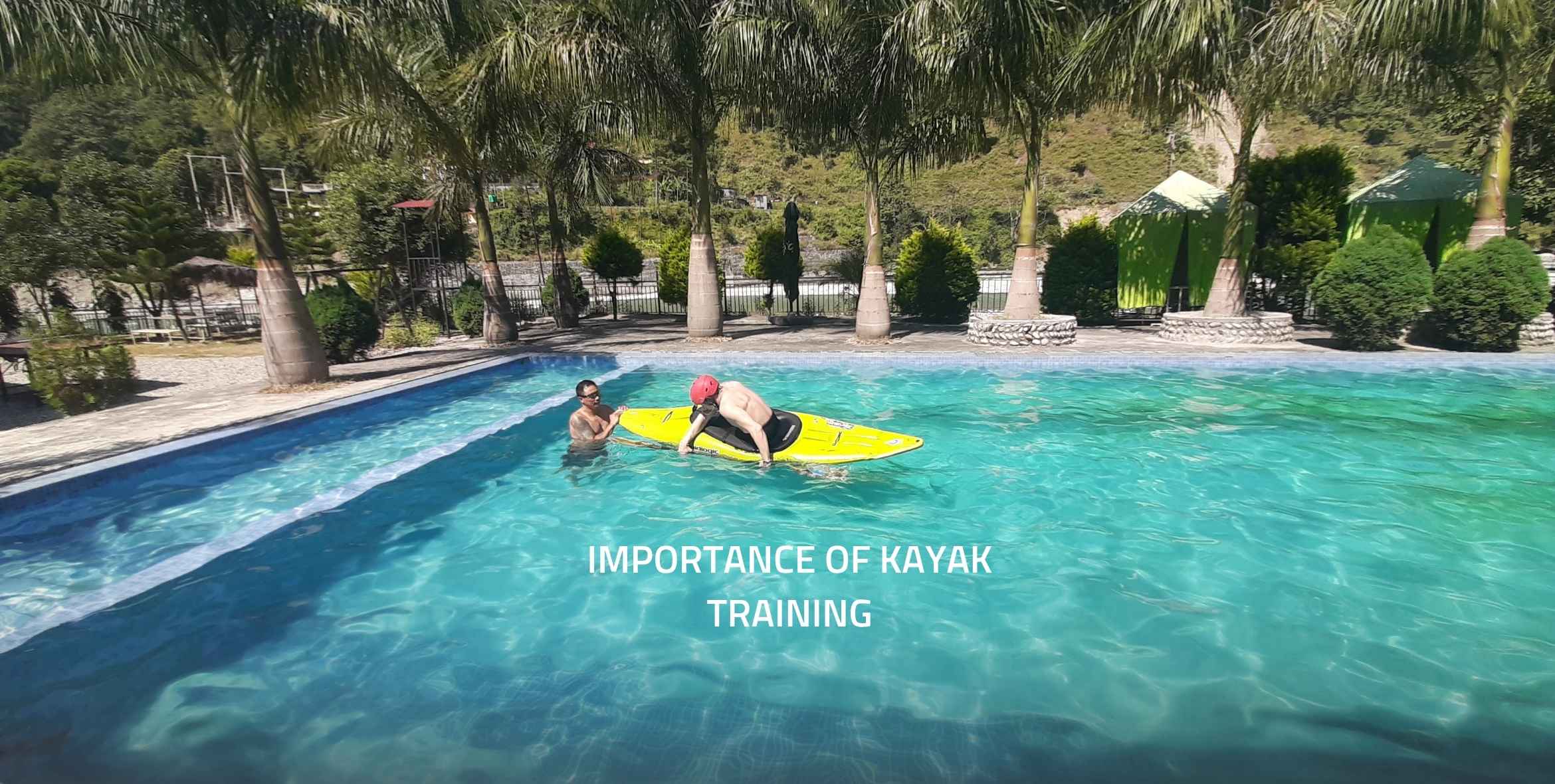
- Spending time in a pool ahead of your trip is one of the best ways to build sport-specific upper body endurance. Even though you will always wear an industry-approved, high-flotation PFD (life jacket) and be backed up by our safety team on the river, being a confident swimmer dramatically increases your comfort level when executing wet exits or rescue drills.
These are a few reasons, if not all, to encourage you to train your body properly before you hit the kayak. You benefit from all the training you do, and you enjoy the water without muscle cramps or pain.
Enjoy your off-season training, stay safe, and we will see you on the rapids for our major autumn and spring trips!