Rafting vs Kayaking in Nepal
High above the clouds, Himalayan ice melts into clear streams, tumbling off glaciers and carving wild white rivers through green mountain gorges. Travelers usually arrive in Nepal with trekking boots tied to their packs, but the country's true pulse runs through these glacial valleys. Choosing how to ride that water comes down to two very different crafts: a heavy rubber raft or a nimble plastic kayak. One gathers a crew to charge through wave trains as a team. The other straps you into a solo boat where every stroke, roll, and river line belongs to you alone.
Among the most popular river activities are whitewater rafting and whitewater kayaking. They both offer an exciting way to navigate Nepal's rivers, but differ in terms of skill level, technique, and overall experience. Understanding these differences can help you choose the adventure that best suits your interests, experience, and travel goals.
Rafting vs Kayaking
| Feature | White Water Rafting | White Water Kayaking |
|---|---|---|
| Watercraft | Heavy-duty, multi-chambered inflatable raft | Small rigid hardshell (or inflatable) kayak |
| Group Size | 6 to 8 paddlers per boat, plus 1 certified lead guide | 1 paddler per boat; double-seater tandem kayaks appear rarely |
| Primary Equipment | Single-bladed T-grip paddle, high-flotation PFD, helmet | Double-bladed paddle, neoprene spray skirt, PFD, helmet |
| Skill Level | Beginner-friendly; no prior experience needed | Intermediate to Advanced; formal technical training required |
| Control & Navigation | Shared team paddling directed by a certified guide sitting at the stern | Full individual control using paddle strokes, edge angles, and body weight |
| River Difficulty | Class I to V rapids, matched to team skill and water levels | Class I to V rapids; Class V requires advanced solo maneuvering and roll recovery |
| Physical Demand | Moderate: Short, synchronized paddling bursts | High: Continuous paddling, edge control, and core balance |
| Best For | Families, corporate groups, first-timers, and social trips | Independent paddlers, skill-builders, and thrill-seekers |
What Is White Water Rafting?
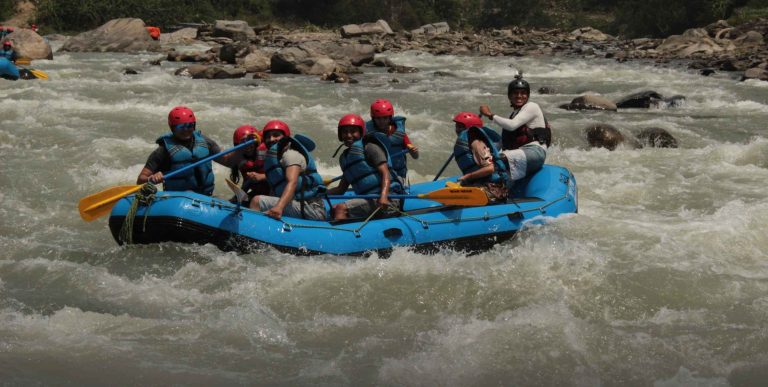
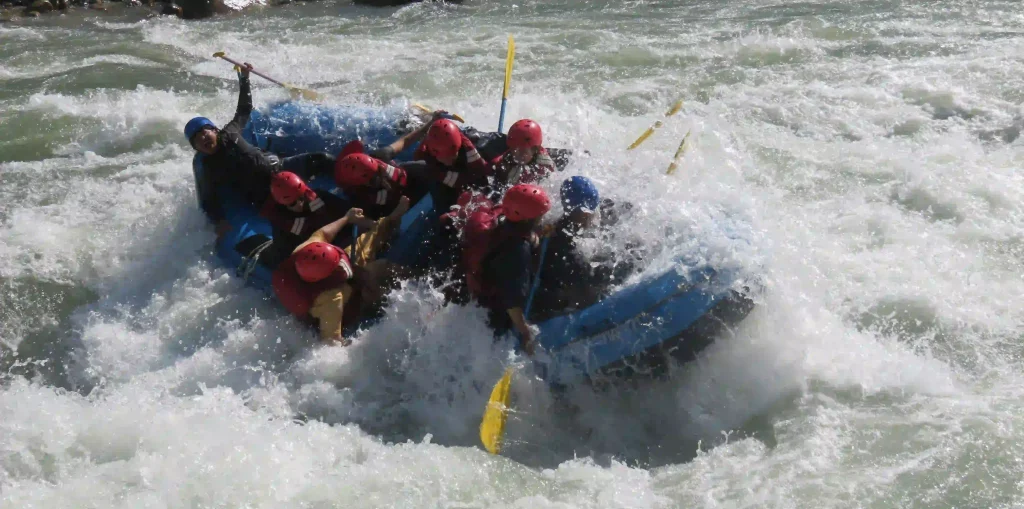
Whitewater rafting relies on coordinated crew effort inside a heavy-duty inflatable boat built from thick PVC or Hypalon. Picture sitting on the outer rubber tube, holding a T-grip paddle, with mountain spray splashing against your face as the quiet river suddenly turns into a roaring wall of white water. Downstream, the multi-chambered raft flexes over massive wave troughs, bounces off smooth granite boulders, and holds high buoyancy through heavy drops. Every person on board shares that exact momentum, working in tandem to keep the boat moving along the right line.
Team rhythm dictates every move. Every participant uses a single-bladed paddle, digging deep into the current to match commands shouted over the roar of the river. A licensed guide sits at the stern, reading the water downstream, setting the angle with a long guide paddle or stern oars, and calling out direct instructions like "Forward hard!", "All back!", or "Get down!" To run a clean route, the entire crew must execute those orders instantly without second-guessing the call.
Because an expert trip leader takes full responsibility for reading currents and making split-second tactical steering decisions, rafting opens up wild river canyons to almost anyone. First-time visitors, family groups, and friends travelling together can drop straight into splashy Class III and technical Class IV rapids safely without years of personal preparation. That mix of group camaraderie, deep canyon views, and shared high-water action makes rafting one of the most popular ways to experience Nepal's river valleys.
What Is White Water Kayaking?
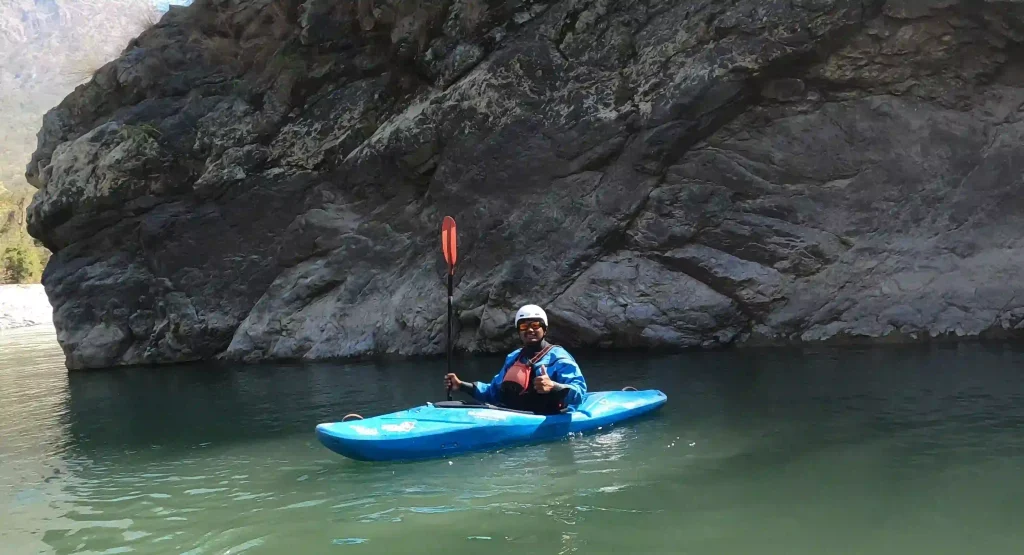
Whitewater kayaking strips away the safety net of a group boat and places a single paddler in complete charge of a compact, rigid plastic hardshell. You sit low near the waterline with your legs extended forward, braced firmly against interior thigh hooks and foot blocks. A waterproof neoprene spray skirt seals tightly around your waist and grips the rim of the open cockpit, keeping the river from flooding your hull as you slice through wave crests and punch through deep holes.
Using a double-bladed paddle, you switch strokes from one side to the other to move, turn, and stay balanced. Since there is no guide steering the boat, every decision is yours. You rely on your paddle, balance, and body movements to navigate currents, avoid rocks, and stay in control as the river changes around you.
Learning to handle a hardshell kayak demands significantly more dedicated practice than jumping into a raft. Mastering the kayak roll stands out as the fundamental breakthrough skill. If a heavy wave flips you upside down into the cold current, a swift hip snap paired with a sweeping paddle arc brings your boat right side up without forcing you to pull your spray skirt and swim. While that technical training requires patience and effort, solo kayaking gives you total freedom to carve through narrow channels, surf standing river waves, and read mountain waters on your own terms.
What Makes Rafting Different from Kayaking?
White water rafting and white water kayaking may take place on the same rivers, but they offer two very different experiences. Rafting focuses on teamwork and guided navigation, making it ideal for beginners and groups. On the contrary, kayaking emphasizes individual control, technical skills, and precision. The differences in boat design, paddling style, skill requirements, and overall experience make each activity unique.
Boat Design and Materials
Boat construction sets the base for this gap. A wide, air-filled rubber raft sits high on the surface, acting like a floating shock absorber. It rides over steep wave crests, bounces off rock walls safely, and holds high stability even if a crew takes an awkward line through a drop. A hardshell kayak moves more like a sharp knife. Sitting low in the water, its narrow plastic hull cuts straight through wave tops and turns on a dime, making the boat fast and responsive but far quick to capsize if your body weight shifts off balance.
Paddling Style
Rafting relies on a single-bladed T-grip paddle. Every person on board digs their blade into the current at the exact same moment, working in explosive team bursts when the guide shouts a command. Kayaking uses a double-bladed paddle. You switch strokes continuously from left to right, driving the boat forward, setting your boat's angle, and adjusting trim. That constant motion keeps your shoulders, arms, and core engaged through every yard of moving water.
Teamwork vs. Independence
Rafting draws its energy from shared group effort. The whole crew paddles as a single unit, relying on a certified lead guide sitting at the stern to read the water, set the river angle, and steer through narrow drops. Kayaking strips away that group safety net. You sit alone. Every line choice, paddle stroke, and eddy turn rests squarely on your personal judgment. That independent setup creates a deep personal challenge, while rafting builds instant camaraderie among friends, families, and corporate groups.
Stability and Balance
Width and air capacity give rafts massive natural stability. Their broad, flat bottoms stay level through heavy splashes, making them forgiving even when a crew takes an awkward entry into a wave train. Kayaks demand active personal balance. Sitting right at the waterline, a kayak responds immediately to every shift in your hips. Lean the wrong way at an eddy line, and the edge catches, flipping you into the current in an instant.
Maneuverability
Big inflatable rafts need space and time to change direction. Trip leaders read the river hundreds of yards ahead, lining up drops early and using heavy momentum to punch through wave holes. Kayaks spin on a dime. Their lightweight plastic hulls let experienced paddlers execute rapid pivot turns, dart into tight rock gardens, surf standing river waves, and park inside micro-eddies where a raft could never fit.
Learning Curve
Rafting lets complete beginners jump right into the action. Guided by an expert trip leader who handles technical navigation, first-timers can safely run bouncy Class III and IV rapids on their very first day out. Kayaking takes patient practice. Before taking on real mountain whitewater, solo paddlers must spend time learning edge control, current reading, wet exits, and the kayak roll—the fundamental technique used to flip your boat upright after capsizing.
Best Rivers in Nepal for Rafting
Nepal is home to some of the world's finest whitewater rivers, offering everything from beginner-friendly day trips to challenging multi-day expeditions. So, you'll find all kinds of experiences, from your first rafting experience to an adrenaline-filled kayaking adventure. Each river has its own character, difficulty level, and scenery. The best rivers for rafting are:
| River | Best For | Trip Duration |
|---|---|---|
| Trishuli River | Beginners, families, day trips | 1-2 days |
| Lower Bhote Koshi River | Action-packed, fast-paced technical day run near Kathmandu | 1 day |
| Seti River | Families and scenic floats | Half day-2 days |
| Kali Gandaki River | Adventure seekers and multi-day trips | 3 days |
| Sun Koshi River | Long rafting expeditions | 8-10 days |
| Karnali River | Remote wilderness expeditions | 10 days |
| Marshyangdi River | Expert whitewater enthusiasts | 1-2 days |
Trishuli River
Running alongside the highway between Kathmandu and Pokhara, the Trishuli River is Nepal's most popular rafting destination. Its fun Class II-III rapids make it an excellent choice for first-time rafters, families, and anyone looking for an exciting day trip.
Lower Bhote Koshi River
The Bhote Koshi drains high glacial lakes along the Tibetan border, cutting a steep canyon down toward the Araniko Highway. Commercial single-day raft trips start below the upper gorges at Khadichaur and finish downstream near Sukute Beach. This lower stretch runs at Class III / III+. The water moves fast, waves stack closely together, and crews get very little rest between rapids. Monsoonal landslides ruined the upper riverbed years ago. Those upper drops carry severe hazards and remain restricted strictly to expert kayakers.
Seti River
These are two separate rivers in different regions of Nepal. The Upper Seti sits thirty minutes outside Pokhara, feeding directly off Annapurna glacial runoff. Paddlers get ninety minutes of continuous Class III+ whitewater in cold, clear water. The Lower Seti flows past Damauli, hours away from Pokhara. It drops into a warm two-day Class II run with long flat pools, forest views, and sandbar campsites. Families and first-time kayak students book the Lower Seti for easy multi-day trips.
Kali Gandaki River
Flowing through the world's deepest gorge, the Kali Gandaki River combines thrilling Class III-IV rapids with spectacular Himalayan scenery and traditional villages. Most trips last around three days, offering a perfect mix of adventure and cultural experiences.
Sun Koshi River
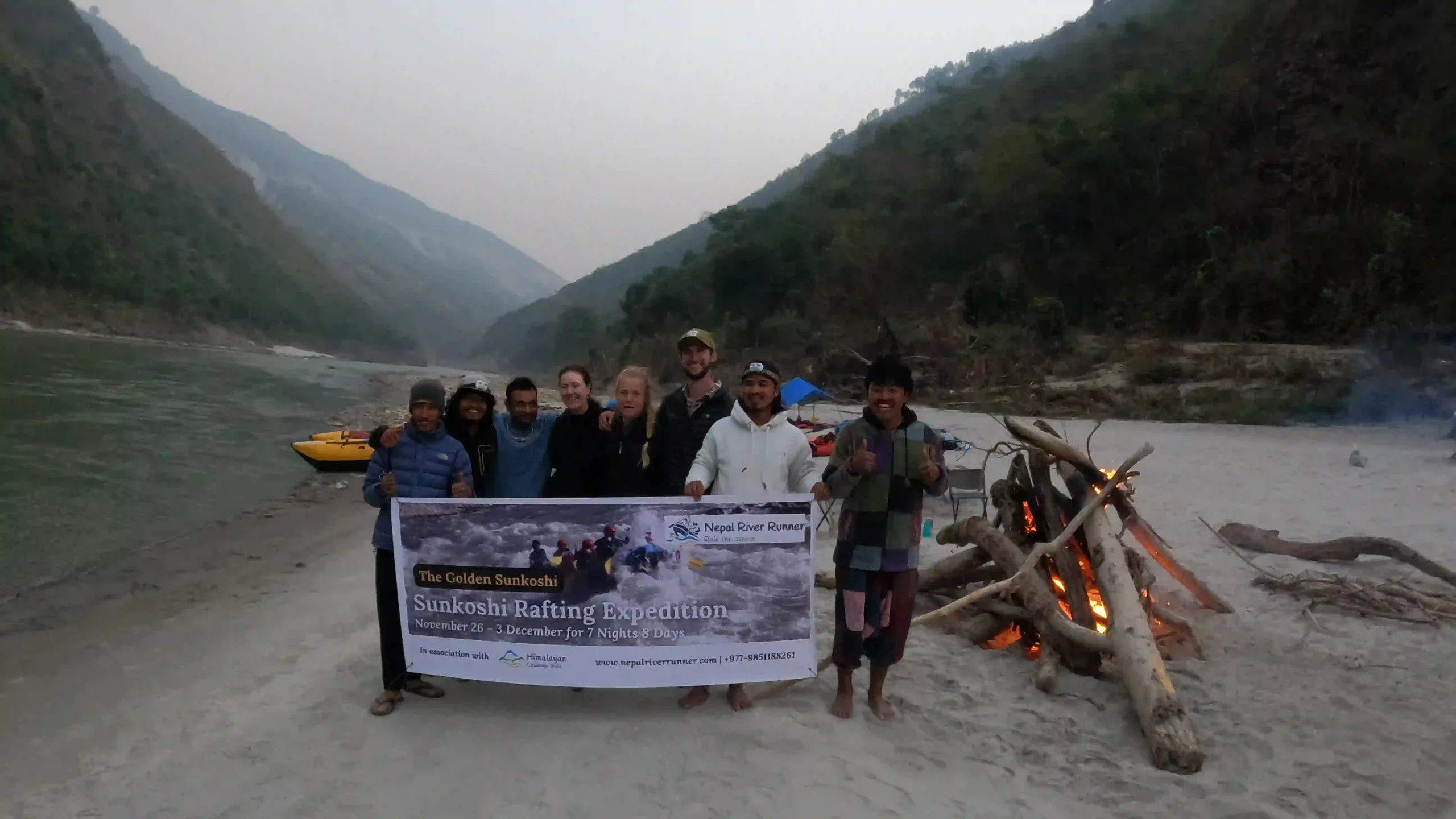
Often called the "River of Gold," the Sun Koshi River is one of the world's classic multi-day rafting expeditions. Stretching over 270 km, this 8-10 day journey passes through remote valleys, deep canyons, and diverse landscapes before reaching Nepal's Terai region.
Karnali River
The Karnali River is Nepal's longest and most remote river expedition. This 10-day wilderness adventure takes you through untouched forests, dramatic gorges, and wildlife-rich landscapes before ending near Bardia National Park.
Marshyangdi River
Concrete hydropower dams now block several stretches of the Marshyangdi valley, ending the old multi-day expedition routes. Paddlers now focus on free-flowing sections near Besisahar. Outfitters run these as technical single-day Class IV / IV+ trips. The riverbed drops sharply through dense boulder fields. Teams need fast paddle strokes and quick crew communication to keep rafts on line through these narrow chutes.
Best Rivers in Nepal for Kayaking
Many of Nepal's best rafting rivers also double as excellent kayaking destinations. However, the ideal river for kayaking depends largely on your skill level, as each offers different water conditions, technical challenges, and rapid grades. From beginner-friendly sections to demanding Himalayan rapids, there's a river suited to every stage of your kayaking journey.
Beginner Kayaking Rivers
The Lower Seti, Trishuli, and Lower Bhote Koshi offer ideal conditions for learning whitewater kayaking. The Lower Seti features warm pools and gentle Class II water near Damauli, making it a comfortable spot for practicing wet exits, edge control, and roll recovery. The Trishuli provides splashy Class III wave trains with deep, calm recovery pools below every rapid. For paddlers who have mastered basic rolls and want to try continuous water, the Lower Bhote Koshi (Class III) delivers fast, bouncy wave trains from Khadichaur down toward Sukute.
Intermediate Kayaking Rivers
Once you can catch eddies and handle Class III water confidently, the Kali Gandaki and Upper Seti offer the next logical step up. The Kali Gandaki delivers a classic three-day trip with medium-volume wave trains and technical boulder lines through a deep mountain canyon. Just outside Pokhara, the Upper Seti presents a cold, fast-paced Class III+ / IV mountain run where continuous glacial runoff forces quick decisions and precise boofs inside a tight gorge.
Advanced Kayaking Rivers
Experienced kayakers looking for technical challenges can target the Marshyangdi, Thuli Bheri and Humla Karnali. While hydropower dams have shortened the Marshyangdi's classic route, free-flowing sections near Besisahar still deliver steep Class IV / IV+ runs with tight rock chutes and heavy hydraulics. In Far West Nepal, the Humla Karnali serves as an intense Class IV–V wilderness expedition that requires flying into Simikot, carrying gear-packed boats through deep canyons, and portaging unrunnable sieves. (Note: The Upper Bhote Koshi remains off commercial schedules due to severe upper-canyon hazards).
Which Offers More Adrenaline and Challenge?
Neither is objectively more exciting among these two water sports. They simply deliver adrenaline in different ways. Rafting offers a shared thrill fueled by teamwork and unpredictable rapids, while kayaking provides a more personal challenge that depends entirely on your skills, technique, and decision-making.
In a raft, the excitement comes from taking on powerful rapids as a team. Charging into towering waves, splashing through turbulent water, and working together to stay on course create an energetic and social experience. If the raft flips, everyone ends up in the river together, adding to the sense of adventure.
Kayaking offers a different kind of thrill. Sitting close to the water makes every rapid feel bigger, and every move is entirely up to you. You'll need to read the river, choose the best line, avoid obstacles, and stay calm if your kayak capsizes. While rafting is easier to learn, kayaking presents a much greater technical challenge, making every successful rapid feel even more rewarding.
Comparing River Grades for Rafting and Kayaking
Rivers around the world are graded using the International Scale of River Difficulty, which classifies rapids from Class I (easy) to Class VI (extreme). While these grades apply to both rafting and kayaking, the level of challenge varies depending on the type of watercraft. A rapid that feels exciting in a guided raft may require advanced technical skills in a kayak.
- Class I - Easy: These rivers have gentle currents with small ripples and very few obstacles. They are perfect for scenic rafting trips and an excellent place for first-time kayakers to build confidence.
- Class II - Novice: Class II rapids feature straightforward waves, wider channels, and clear routes. Rafts pass through comfortably with guidance, while beginner kayakers can start practicing basic turning, steering, and boat control.
- Class III - Intermediate: With larger waves, narrower channels, and moderate obstacles, Class III offers a noticeable step up in excitement. Rafters can expect plenty of splashes and bouncing through the rapids, while kayakers need good boat control, the ability to read the river, and confidence in self-rescue techniques like the kayak roll.
- Class IV - Advanced: These rapids are powerful, fast-moving, and filled with technical features. Rafting teams must work closely with an experienced guide to stay on course and avoid flipping. Kayakers need advanced paddling skills, quick decision-making, and precise control to safely navigate the river.
- Class V - Expert: Class V rapids are long, violent, and highly demanding, with steep drops, powerful currents, and significant hazards. Rafting is only recommended with highly experienced guides and skilled crews, while kayaking at this level is reserved for expert paddlers with extensive whitewater experience.
- Class VI - Extreme: Class VI rapids represent the absolute physical limit of river difficulty. They feature massive unpredictable drops, dangerous rock sieves, and lethal water pressure where a swim carries severe consequences. Commercial outfitters never run Class VI water under any circumstances. Only sponsored, elite kayakers attempt these hazardous runs after extensive safety planning, portage reconnaissance, and specialized team backup on the banks.
Physical Fitness Requirements
Both rafting and kayaking require a basic level of physical fitness, but kayaking is generally more demanding because you're responsible for controlling the boat on your own.
White Water Rafting
- Requires moderate upper-body strength for paddling through rapids.
- Good core stability helps you stay balanced during bumpy sections.
- Suitable for most beginners and recreational travelers.
- Swimming is recommended on beginner rivers like the Trishuli, but high-buoyancy life jackets and professional guides provide added safety.
- Strong swimming ability is recommended for advanced Class IV and V rivers.
White Water Kayaking
- Requires good upper-body strength and core endurance for continuous paddling.
- Hip flexibility and balance are essential for controlling the kayak.
- A confident swimming ability is necessary, as capsizing is a normal part of the sport.
- Learning self-rescue techniques, such as the kayak roll, is important before attempting more challenging rivers.
- Best suited for people who are comfortable with physically demanding outdoor activities.
Which Activity Is Better for Families and Groups?
If you're traveling with family or a group of friends, white water rafting is usually the better choice. It brings everyone together in the same raft. You paddle as a team, cheer each other on, and share every splash, rapid, and laugh along the way. Family-friendly rivers like the Lower Seti are also suitable for young children, while rivers such as the Trishuli offer just the right amount of thrill for older children, teenagers, and first-time adventurers.
White water kayaking, on the other hand, is a much more individual experience. Even when you're kayaking with friends, each person paddles their own boat and navigates the rapids independently. You may stop together between sections of the river, but once you're back on the water, everyone focuses on their own route and technique.
So, rafting offers a more social, beginner-friendly, and memorable experience for most families, first-time visitors, and larger groups. Kayaking is a better fit if everyone in your group already has paddling experience or if you're joining a kayaking course together to learn and improve your skills.
Rafting vs Kayaking Costs in Nepal
The cost of white water rafting and kayaking in Nepal depends on the river, trip duration, and what's included in the package. White rafting is generally the more affordable option. Kayaking costs more due to specialized equipment and personalized instruction.
White Water Rafting Costs
- Single-day trips (Trishuli, Lower Bhote Koshi or Seti): USD 45 to USD 85 per person. This rate covers round-trip private transport from Kathmandu or Pokhara, licensed lead river guides, dedicated safety kayakers, river permits, technical safety gear (PFDs, helmets), and a freshly prepared lunch.
- Multi-day expeditions: 3-Day Expeditions (Kali Gandaki): USD 180 to USD 300 per person. Rate includes all river meals, high-grade camping gear, support crew logistics, and road transfers.
- Long Wilderness Expeditions (Sun Koshi, Karnali): USD 700 to USD 1,600 for an 8 to 10-day journey. These remote trips cover full expedition logistics, professional camp cooks, heavy cargo rafts, and dedicated safety kayak escorts throughout the run.
- Usually includes: Transportation from Kathmandu or Pokhara, professional river guides, safety equipment, meals, and camping gear for overnight trips.
White Water Kayaking Costs
- Beginner kayaking clinics: A 4-day course generally starts at around USD 600 per person.
- Usually includes: Professional instruction, kayak and safety equipment, meals, riverside accommodation or camping, and support throughout the training.
Although kayaking requires a higher upfront investment, it includes specialized coaching and equipment. Rafting, on the other hand, remains the more budget-friendly option for travelers looking to experience Nepal's rivers without extensive training.
How to Choose the Right River Adventure for Your Travel Style
The best river adventure depends on your experience, travel companions, budget, and the type of experience you're looking for. Use these factors to decide which option suits you best.
Choose Rafting If:
- You're looking for an exciting adventure without prior experience.
- You're traveling with family, friends, or a larger group.
- You're short on time and prefer a half-day or full-day trip.
- You're looking for a budget-friendly outdoor activity.
- You'd rather have a professional guide handle the technical navigation.
Choose Kayaking If:
- You're interested in learning technical paddling skills.
- You're looking for a more independent adventure than coordination.
- You have several days available for a kayaking clinic or course.
- You're comfortable investing more in specialized equipment and instruction.
- You're physically fit and confident in swimming in moving water.
Whether you choose rafting or kayaking, Nepal's rivers offer unforgettable scenery, thrilling rapids, and experiences suited to every type of adventurer. The right choice ultimately comes down to how you like to explore, learn, and challenge yourself.
Conclusion
Rafting and kayaking put you right at the waterline inside Nepal’s deepest mountain canyons, but they deliver two completely different experiences once you drop into moving current. Rafting relies on group energy, synchronized paddle strokes, and a certified lead guide steering from the stern. Kayaking hands you a double-bladed paddle, seals you into a single cockpit, and tests your personal edge control, line choice, and roll recovery against the river’s power.
Choosing between the two craft comes down to your group setup, available time, and personal goals on the water. First-time visitors, family groups, and social teams can step straight onto a raft and run splashy Class III and IV rapids with zero prior training. Solo travelers and thrill-seekers looking to build real technical boat-handling skills will find multi-day kayak clinics far more rewarding.
Ready to experience Nepal beyond the trekking trails? Explore our guided white water rafting and kayaking trips, and let our experienced river guides help you find the perfect adventure for your skill level, schedule, and travel style.