Best Rivers for Rafting in Nepal
As expanding road networks continue to change traditional trekking routes like the Annapurna Circuit, rafting offers a different way to experience Nepal. From short whitewater runs to multi-day wilderness expeditions, the best rivers for rafting in Nepal take you through deep gorges, remote valleys, and changing landscapes.
But each river has its own character. The Sun Koshi is a classic choice for a longer rafting expedition, while the remote Karnali offers a more isolated journey through western Nepal. Rivers like the Bhote Koshi, Trishuli, Seti, and Tamur bring their own mix of rapids, scenery, difficulty, and trip length.
Why Nepal Is One of the Best Rafting Destinations in the World
Few places on Earth pack the vertical drama that Nepal does. Rivers here begin as glaciers and snowmelt high in the Himalaya, then lose thousands of meters in elevation over a relatively short distance. That steep gradient creates powerful whitewater as rivers carve through gorges, boulder gardens, and narrow canyons on their way down.
This combination of Himalayan gradient, glacier-fed volume, and dramatic scenery makes Nepal a major whitewater destination. But what makes it especially appealing for a rafting trip is the range of experiences available. A first-timer can find Class II-III water within easy reach of Kathmandu, while experienced rafters can seek out Class IV-V rapids on more technical rivers. Similarly, those with more time can go further, joining multi-day expeditions through remote valleys with riverside beaches, small villages, and stretches of wilderness far from the main roads.
Whether you have an afternoon or two weeks, there is a Nepali river to match your time, experience, and appetite for adventure.
Trishuli River - Nepal's Most Popular Rafting River
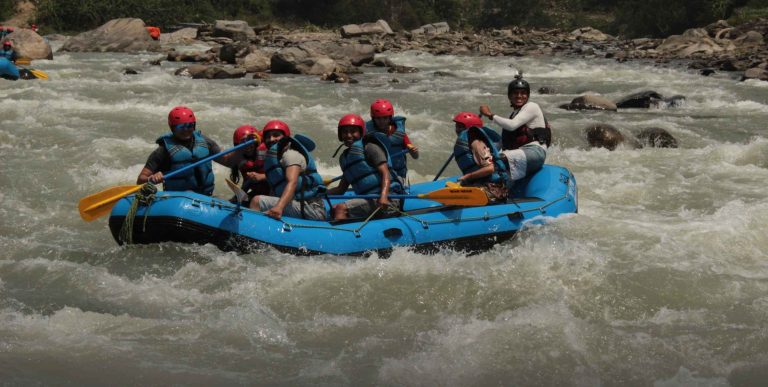
The Trishuli is Nepal's most popular and accessible commercial rafting river, and for good reason. Running alongside the Kathmandu-Pokhara highway, it is easy to reach from Kathmandu, Pokhara, and Chitwan. The river has a classic pool-and-drop character, with Class II to III+ rapids followed by calmer stretches where rafters can swim and float. That mix makes it a good choice for first-time rafters, families, and travelers who want exciting whitewater without committing to a remote expedition.
Trishuli rafting can range from a 1-day to 3-day trip, with routes covering roughly 15 to 60 km depending on the itinerary and water conditions. Standard one-day trips are commonly put in at Charaudi or Fishling and run toward Kuringhat or Mugling, covering around 15-30 km. Longer itineraries may start farther upstream at Baireni (Bhaireni) and continue toward Simaltal or Gai Ghat near the Devghat confluence, covering up to around 60 km.
On our 1-day Trishuli River rafting trip, the rafting starts at Charaudi and ends at Kuringhat. Along this section, you'll encounter rapids including Twin Rocks, Ladies' Delight, Upset First, Surprise, and Butterfly, alongside impressive gorges, valleys, and riverside villages. The trip also includes opportunities for swimming and cliff jumping at suitable spots along the route.
Bhote Koshi River - NRR's Favorite for High-Adrenaline Whitewater
If Trishuli is the warm-up, Bhote Koshi is the adrenaline rush for travelers who don't have much time to spare. Fed by snowmelt from the Tibetan plateau and the Zhangzangbo Glacier, the river drops rapidly through narrow gorges along the Araniko Highway, creating fast-paced Class III to III+ continuous rapids and whitewater within easy reach of Kathmandu. Its steep gradient, roughly 7 meters per kilometer on the standard run, produces continuous wave trains and powerful hydraulics, leaving little flat water between rapids.
The standard Bhotekoshi River Rafting run covers around 13 km. It starts at Khadichaur (741 m) and ends at Sukute Beach (650 m). Depending on the itinerary, the trip can be extended downstream to Dolalghat, bringing the total distance to around 22 km. The short, intense format makes Bhote Koshi a strong choice for active beginners, youth groups, and intermediate paddlers who want a full day of whitewater without committing to a multi-day expedition.
The river is also closely associated with Nepal's adventure scene, with the country's original bungee jumping site, The Last Resort, located along the same river corridor. For travelers who want to pack multiple adrenaline activities into a single trip, Bhote Koshi pairs easily.
Sun Koshi River - Nepal's Ultimate Multi-Day Rafting Expedition
The Sun Koshi, known as the “River of Gold,” is Nepal's classic multi-day rafting expedition and one of the country's most iconic wilderness river journeys. The roughly 270 km route gradually builds in intensity, starting with Class III wave trains before developing into powerful Class IV to IV+ rapids farther downstream. With remote jungle gorges, changing landscapes, and long stretches away from roads, it offers the kind of extended wilderness experience that shorter rafting trips simply cannot match.
The expedition generally takes 7 to 10 days, depending on the itinerary and river conditions. Routes can put in around Dolalghat or Sukute and follow the river eastward, passing major confluences including the Tama Koshi, Dudh Koshi, and Arun before reaching Chatara. Along the way, rafters encounter well-known rapids such as Harkapur I and II, Meat Grinder, Dead Man Eddy, and Rhino Rock, with the river becoming progressively more challenging as the expedition progresses.
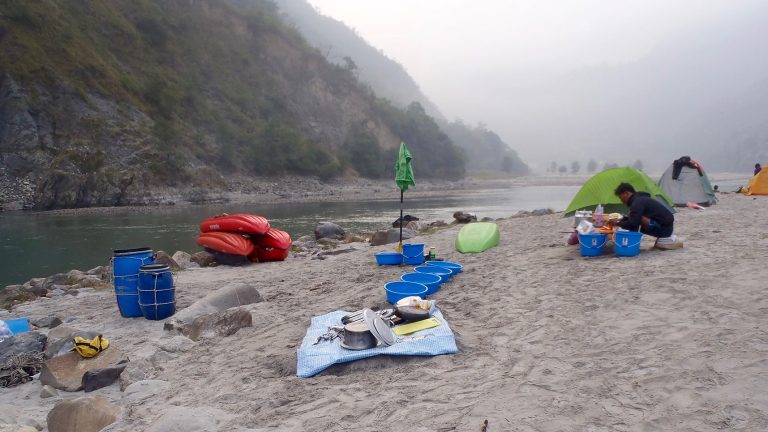
The days follow a steady rhythm of paddling through whitewater, stopping along calmer stretches, and camping on remote riverside beaches. So, you can also easily combine a fishing trip, giving you time to cast along quieter sections of the river between rapids. With its long expedition format, progressive whitewater, and wilderness camping, the Sun Koshi suits experienced paddlers and expedition enthusiasts seeking a longer fishing-and-rafting adventure in Nepal.
Karnali River - Nepal's Longest Wilderness Rafting Adventure
The Karnali is Nepal's longest river and the country's ultimate wilderness rafting expedition. Originating near Mount Kailash, it drains through the remote western region and carries rafters through isolated jungle canyons and deep valleys far from the country's busier tourism routes. The river brings a mix of Class III to V whitewater, combining powerful, high-volume rapids with calmer stretches that give the journey time to breathe.
The standard expedition covers around 180 km over 10 days. The trip starts in Tallo Dhungeshwor or Sauli, accesses the river through Surkhet, and ends at the Chisapani Bridge near the wildlife-rich Bardia National Park.
The Karnali River rafting feels like more than a rafting trip; it's a journey through Nepal's Wild West. Wide white sandy beaches, jungle surroundings, and isolated valleys create a river safari atmosphere between the rapids, making the experience as much about wilderness as whitewater. It suits adventure seekers looking for a remote, multi-day expedition that combines rafting, wilderness camping, and wildlife.
Marsyangdi River - Nepal's Most Technical Rafting Experience
The Marsyangdi, known as the "Raging River," is for rafters who have already done the easier runs and want something more demanding. Rising on the northern slopes of Annapurna and flowing through the Manang Valley before joining the Trishuli near Mugling, it is one of Nepal's steepest and most continuous commercial rafting rivers. Hydroelectric development has shortened its historical multi-day route, leaving behind a concentrated 2-day run of relentless Class IV to IV+ boulder gardens with very little flat water between rapids.
Day one starts at Bhulbhule (800 m) and drops roughly 9.8 meters per kilometer over 14.3 km to Phaliyasangu (660 m), just above the Middle Marsyangdi reservoir. From there, it's a 1-hour drive to Paundi for overnight camping. Day two continues from Paundi (540 m), covering 13.8 km at a similarly steep 8.7 meters per kilometer to the take-out at Turture (420 m), above the downstream hydro reservoirs. Along both days, sustained technical whitewater runs through dramatic Himalayan landscapes and local settlements.
The Marsyangdi River Rafting tour suits advanced rafters and skilled kayakers seeking continuous, technical paddling. It is not a beginner or casual family rafting option.
Kali Gandaki River - Raft Through the World's Deepest Gorge
Named after the Hindu goddess Kali, the Kali Gandaki River carries deep religious significance in Nepal. Geographically, it is just as striking, cutting through the gorge between Annapurna and Dhaulagiri, both above 8,000 meters. The river's dramatic setting, combined with its sandy riverside beaches and traditional villages, makes it one of Nepal's most scenic rafting destinations.
On the water, the Kali Gandaki offers a busy, engaging run rather than a few isolated bursts of whitewater. Rafters can expect Class III to IV+ rapids over a typical 55 km, three-day journey, with the route starting at Maldhunga near Kusma and ending at the Mirmi Dam reservoir. Rapids arrive frequently, keeping the trip active while still leaving enough calmer stretches to take in the surrounding landscape.
Between the rapids, towering canyon walls, side waterfalls, terraced hillsides, and Magar and Chhetri villages provide a constantly changing backdrop, with views toward the Annapurna range along the route. Its location also makes the Kali Gandaki a natural addition to an Annapurna-region trekking itinerary, making it a strong choice for intermediate rafters who want a compact three-day expedition that combines technical whitewater, mountain scenery, and riverside culture.
Seti River - The Best Family-Friendly Rafting Experience
The Seti River is one of Nepal's gentlest commercially rafted rivers. It is a natural choice for first-timers, families with young children, and anyone who wants scenic rafting without intense technical rapids. Its warm water and straightforward Class II to III rapids create a relaxed experience, with plenty of calmer stretches for swimming, floating, and enjoying the surrounding landscape. The roughly 35 km route can be completed in one to two days, typically starting near Damauli and ending at Gai Ghat, where the Seti meets the Trishuli.
The appeal here is more about atmosphere than adrenaline. The river winds through forested valleys, terraced farmland, and quiet rural settlements, with opportunities to spot birdlife and experience a less hurried side of Nepal. Its gentle character also makes it a good introduction to rafting for people who may later want to progress to more demanding rivers such as the Trishuli or Bhote Koshi. For a low-stress river trip with family-friendly whitewater and plenty of time to enjoy the surroundings, the Seti River Rafting and Fishing is the best option.
Tamur River - The Ultimate Trek-and-Raft Expedition
Draining the slopes of Kanchenjunga, the world's third-highest peak, the Tamur is eastern Nepal's premier trek-and-raft expedition. Reaching this unique river itself is part of the adventure: the journey typically begins with a 3- to 4-day trek from Basantapur to Dobhan, passing through remote hill villages before the rafting even starts. This makes Tamur River Rafting less conventional and more of a complete wilderness expedition for travelers who want to combine trekking and whitewater in one journey.
Once on the water, the roughly 120 km river section delivers an intense run of Class IV to IV+ rapids, with some sections reaching Class V, through narrow granite gorges and remote landscapes. The full itinerary takes around 9 to 13 days and ends at Chatara after the river section. With challenging whitewater, a multi-day trek, and limited access to the outside world, the Tamur suits physically fit travelers with previous rafting experience seeking an off-the-beaten-path adventure.
Bheri River - Relaxed Wilderness Rafting with Excellent Fishing
If you want to slow down between rapids, you should consider Bheri River Rafting. Its relatively mild Class II to IV rapids leave room for fishing, wildlife spotting, and taking in the remote landscapes along the river. Wide sandy beaches provide natural camping spots, while forests, rural settlements, and quiet stretches of water make the journey feel far removed from busier rafting routes in Nepal.
The Bheri lies in the remote west. Formed by the Sani Bheri and Thuli Bheri rivers, the rafting route runs from Devisthal to Chisapani. It covers roughly 142 km and typically takes five to six days, combining manageable whitewater with fishing opportunities, including the chance to catch golden mahseer. After the rafting trip, travelers can also extend the adventure with a visit to Bardia National Park. This makes Bheri a good choice for those looking for a quieter mix of rafting, fishing, camping, and wildlife.
Arun River - A Hidden Gem for Experienced Rafters
The Arun River offers a quieter take on Nepal's multi-day river adventures. It's for rafters who prefer a less crowded option. Rising at the base of Mount Makalu, the 8,463 m Himalayan peak, the river flows through eastern Nepal before joining the Saptakoshi system. Its Class III to IV rapids keep the journey exciting without reaching the extreme grades found on some of Nepal's more demanding rivers, while sedate riverside beaches provide natural places to camp and unwind between sections.
The roughly 70 km rafting route runs from Katikeghat to Chatara, passing through remote landscapes with opportunities to encounter local Rai and Tibetan-origin communities along the way. Birdlife and wildlife, including eagles, kingfishers, langurs, and deer, add to the experience, while the river's relatively low visitor numbers give the trip an exploratory feel. Best suited to adventure seekers looking for a less-crowded, multi-day wilderness trip, Arun River Rafting is particularly appealing from October to December and March to May.
How to Choose the Right Rafting River in Nepal
With more than a dozen rafting rivers running through the country, picking the right one comes down to a few factors and honest questions:
- Experience level. Are you rafting for the first time, or are you looking for continuous technical whitewater?
- Rapid grade. Nepal's rivers range from Class II, which is generally suitable for beginners and families, to Class V, which requires advanced skills and experience.
- Seasonality. When are you traveling? Water levels and river difficulty can change significantly between seasons. Spring brings higher flows from snowmelt while autumn offers more stable conditions.
- Trip duration. Some rivers can be rafted in an afternoon or a day. Some are multi-day expeditions that can last up to two weeks.
- Scenery and setting. Do you want Himalayan views, deep gorges, jungle and wildlife, or remote riverside beaches?
- Accessibility and travel investment. Are you looking for a river that's easy to reach from Kathmandu or Pokhara, or are you willing to take internal flights and spend longer on the road to reach a remote launch point?
- Comfort level. Are you happy with basic riverside camping and limited connectivity, or would you prefer more comfortable accommodation and facilities along the route?
- Adventure level. Do you want rafting to be the main event, or would you like to combine it with trekking, fishing, kayaking, or cultural stops?
Matching these factors to the right river is key to successful, comfortable whitewater rafting in Nepal.
Nepal’s Himalayan rivers turn the country’s dramatic terrain into a playground for water adventures, from gentle family floats to demanding multi-day expeditions. With routes ranging from accessible day trips to remote wilderness runs, water rafting in Nepal offers a way to experience the Himalayas from a completely different perspective.
From the fast-flowing Trishuli and Bhote Koshi to the remote Karnali and Tamur, each river brings a different mix of whitewater, scenery, and adventure. Here’s what each of the best river rafting adventures in Nepal looks like:
Which Nepal River Has the Best Mountain Views?
The Marsyangdi is the best river for dramatic mountain views, especially if you want to see both Annapurna and Manaslu from the water. The rafting route runs through the Lamjung valley below both ranges, with high Himalayan peaks rising above the river and creating a striking backdrop as you raft. Kali Gandaki comes close, cutting between Annapurna and Dhaulagiri through one of the deepest gorges in the world.
Similarly, the Tamur River also offers a more remote mountain experience beneath the Kanchenjunga massif, the world's third-highest peak. That said, Karnali and Sun Koshi are better choices if you care more about wilderness scenery than constant high-mountain views. Their longer routes descend through forests, valleys, and lower foothills, so the landscape changes more gradually.
For the most dramatic peak views, pick Marsyangdi; for a combination of mountains and deep-gorge scenery, choose Kali Gandaki; and for remote, unique views of the Himalayas, go with Tamur.
Which River Offers the Biggest Rapids?
For sheer size, volume, and power, the Karnali and Sun Koshi offer some of the biggest rapids in Nepal. Their large drainage basins produce powerful, high-volume whitewater, with standout rapids such as God's House on the Karnali and Harkapur on the Sun Koshi. These expedition rivers combine heavy wave trains, strong hydraulics, and large drops that demand confident paddling and teamwork.
If you're after sustained technical intensity rather than sheer water volume, the Marsyangdi is the stronger choice. Its steep gradient and narrow, rock-filled channels create continuous Class IV to IV+ whitewater with little recovery time between rapids. The Lower Bhote Koshi delivers a comparably fast-paced experience on a much shorter run, slightly less steep than Marsyangdi, but still enough to keep things exciting, making it a good option for travelers who want concentrated adrenaline without committing to a multi-day expedition.
All in all, Karnali or Sun Koshi has the biggest big-water rapids, while Marsyangdi offers the most sustained technical challenge.
Which Rafting River Matches Your Adventure Style?
There is no single best rafting river in Nepal for everyone. The right choice depends on the kind of adventure you want. Some rivers are gentle and family-friendly, while others offer technical rapids or long wilderness expeditions. Use the guide below to find the river that fits you best.
| Adventure style | Best river(s) | Why |
| First-time rafters | Trishuli / Lower Bhotekoshi | Accessible, manageable rapids, and easy day-trip options from Kathmandu. |
| Families | Seti / Trishuli | Seti is gentler and warmer; Trishuli offers more excitement while remaining accessible. |
| Couples | Kali Gandaki / Bheri | Dramatic scenery and riverside camping on Kali Gandaki; peaceful wilderness and fishing on Bheri. |
| Adventure seekers | Marsyangdi / Lower Bhote Koshi | Sustained technical whitewater on Marsyangdi; fast-paced Class III–III+ action on Bhote Koshi. |
| Expedition lovers | Sun Koshi / Karnali / Tamur | Long wilderness journeys combining challenging rapids, camping, and remote landscapes. |
| Photography enthusiasts | Marsyangdi / Kali Gandaki | Himalayan peaks, deep gorges, waterfalls, villages, and dramatic landscapes. |
| Corporate groups | Trishuli | Easy access from Kathmandu, flexible trip lengths, and manageable group logistics. |